
Menu
On Thursday 8th and Friday 9th February, representatives from the VISSION consortium met in Warsaw to discuss our progress so far and to prepare for the upcoming Horizon review meeting in March. We were hosted at the Institute of High Pressure Physics of the Polish Academy of Sciences, organised by Prof. Henryk Turski.

We began with the technical discussions, in which the work package leaders presented an overview of their team’s technical progress to date, as well as their schedule for the coming year.
Luceda Photonics have assembled the PDK software package that is used to realise the system designs and the creation of photolithography masks. Iterio Degli-Eredi presented the components that have been included, as well as the testing structures that are being fabricated in the first run, and the roadmap for inclusion of the experimental results generated from them. By incorporating these critical data, the PDK will enable fast and accurate simulation of any system that a photonic designer envisions, minimising the number of prototyping runs needed for new applications.
The passive silicon nitride platform that underpins the VISSION project and enables effective integrated photonics in the visible and near infrared is the responsibility of imec, who are currently working on the manufacture of the first test components and devices. Manuel Reza, from Imec, presented the details of the fabrication process, as well as the current status and the plans for future processes. This initial fabrication run has been priceless for the streamlining of later fabrication cycles, identifying key issues and optimising each stage of the process flow.
Prof. Henryk Turski then took the floor to share the work undertaken at Unipress on gallium nitride-based amplifiers, which will be used in VISSION to generate blue- and green-wavelength light for a range of applications. The layer-by-layer composition of the amplifiers was discussed, including the optimisation of the release layer for micro-transfer printing – the key concept on which VISSION is built and which will enable the large-scale integration of active devices onto the silicon nitride passive platform.
Likewise, Prof. Markus Weyers from the Ferdinand-Braun-Institut detailed the development work for amplifiers in gallium arsenide, which will enable applications using light in the red and near-infrared. Extensive studies and simulations have been carried out, in close collaboration with the team at imec, to optimise and enable the precise structural configurations needed to effectively couple light between the active and passive materials.
Ewout Picavet and Kobe De Geest, PhD students at Ghent University, under the supervision of Prof Beeckman, then explained their work on optoelectronic modulators based on barium titanate and lead zirconate titanate. Electro-optic modulators offer high-speed precise control of the performance of a photonic system and are key to enabling the complex applications that the VISSION project is working towards. Their initial successes show great promise for the future.
Detectors are a necessary element of any complete photonic platform, and at the wavelengths targeted by VISSION, silicon is an ideal material for this purpose. Valeria Bonito Olivia (Imec) presented the development work carried out to date on these, discussing the challenges presented by the requirements of the silicon fabrication platform, as well as the proposed methods to overcome and work around these.
Moving from the component-level to the device level, Mateusz Kotyrba from Sarcura presented the operational principles of the cell flow cytometer that will be one of the VISSION demonstration devices. This is part of Sarcura’s drive to miniaturise, and thus make more accessible and widespread, the systems needed for the preparation of CAR-T cell therapy. This revolutionary process already offers incredible results in the field of blood cancer treatment, but suffers from high cost. By bringing to bear the reduced size, weight, power and cost inherent to the integrated photonic platform, Sarcura will develop a low-cost, mass-manufacturable system for the biopharma industry.
To demonstrate the broad applicability of the VISSION platform, G&H will develop a range of other functional devices through the project. Stuart MacFarquhar presented the groundwork that has been carried out for developing a swept-source optical coherence tomography engine and two narrow-linewidth lasers for quantum applications.
Further to the technical presentations, project management, and planning discussions were held on Friday to refine the project strategy and timeline over the coming 12 months, taking into account both the successes and challenges of the work to date. These were led by project leaders Antonietta Parracino and Bart Kuyken, and were key to preparation for the upcoming meeting with the Horizon project reviewers on the 19th March.
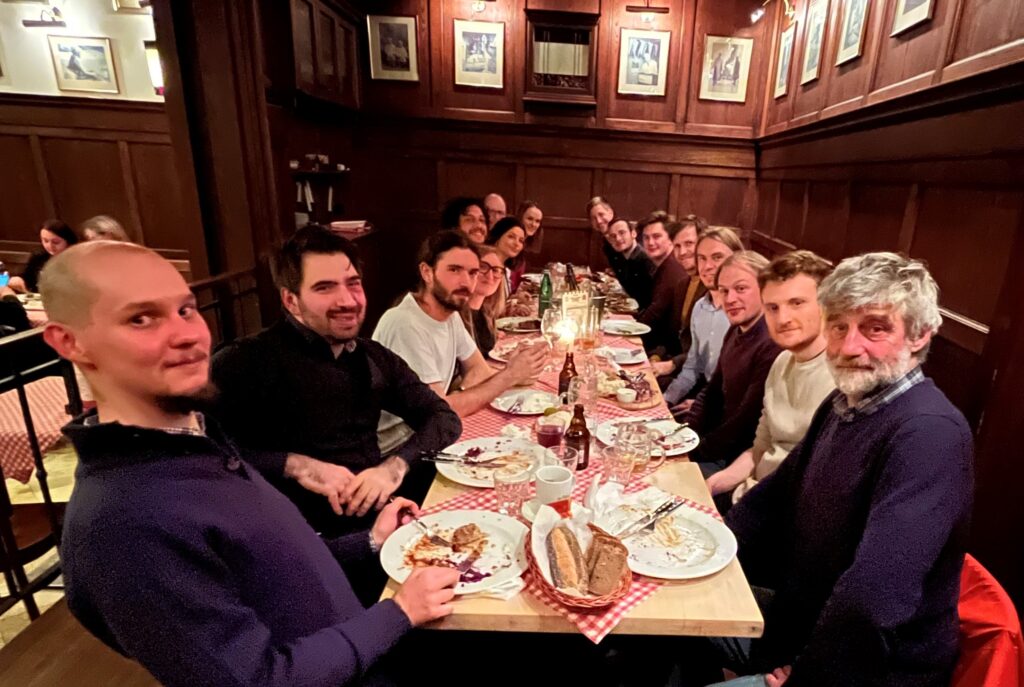
The meeting wasn't solely focused on business matters; the consortium also made time for enjoyment. Members engaged in informal interactions outside the work environment, fostering a positive team spirit. Additionally, we visited the Castle, and we had the opportunity to learn about the history of the city hosting us!
Receive up to date news about VISSION


VISSION is funded by the European Commission through Horizon 2020, and by UK Research and Innovation through Innovate UK, under Grant Agreement 101070622.