
Menu
VISSION is now online! With the launch of both this project website and our media profiles on Twitter and LinkedIn, we will keep the public updated with the progress of the project. Scientific publications will also be announced as they are released, and demonstrations will be made available later in the project.
Following the official launch of the VISSION project at the beginning of September, a kick-off meeting was held at Ghent University on Monday 3rd October. Representatives from all members of the consortium gathered to discuss the designated work packages, share expertise, and review the goals for the next six months. There was then a short tour of the cleanroom facilities in the UGent & imec Technologiepark. Many thanks to all those in attendance for their contributions, and to imec and UGent for hosting the event. The official press release follows.
The visible and near-infrared wavelength range is the region of interest for a large number of biomedical applications, environmental sensing applications and emerging applications such as in the field of quantum sciences. Applications include optical coherence tomography, flow cytometry, environmental sensors to detect water pollution, quantum computers and atomic clocks. These applications will benefit with VISSION from an integrated active photonic platform at visible and near-IR wavelengths. One of the challenges is that these applications need widely spaced wavelengths, sometimes spanning as much as an octave, in the same system. At the same time these systems tend to be complex. Here, we will leverage the existing silicon nitride platform technology by integrating active building blocks on the platform to enable these non-telecom applications. Our modular approach with generic building blocks allows for making complex high performant photonic circuits at visible and near-IR wavelengths.
The 48-month project started on 1 September 2022. It is funded by the European Commission under the Horizon Europe programme with a grant of 656 320 euros and involves seven partners. To this end, the aim of VISSION is to:
VISSION's approach aims to address many challenges and attempts to integrate all major photonic functionalities on a single hybrid photonic integrated circuit: light generation (Lasers), transmission (waveguides), manipulation (modulators) and detection (photodetectors). VISSION will pave the way for a new generation of advanced photonic integrated circuit with unrivalled novel functionalities, which will serve a wide range of applications from biomedical, environmental sensing and quantum systems.
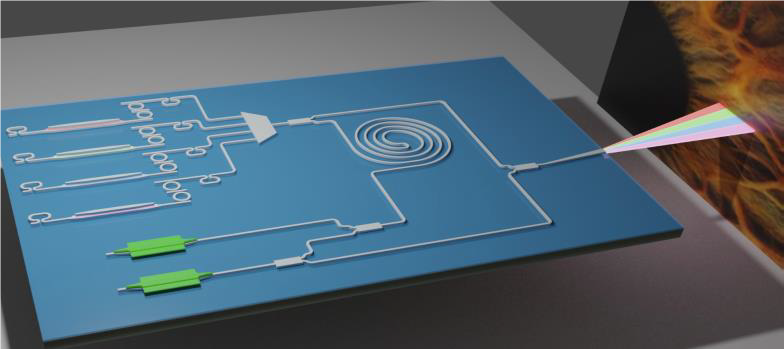
Artist impression of a photonic chip including multiple broadband lasers at different frequencies, sensitive silicon photodetectors and a passive circuit for addressing optical coherence tomography applications.
The VISSION consortium unites the expertise of 7 renowned research entities and industrial players in the photonics field to achieve ambitious objectives within the project runtime of 48 months:
Project Coordinator: Bart Kuyken, UGENT-imec


VISSION is funded by the European Commission through Horizon 2020, and by UK Research and Innovation through Innovate UK, under Grant Agreement 101070622.